Collagen in Midlife — Does It Actually Work?
By Caroline Grey, Founder of Craft Your Body
I was asked this again just the other day: "Collagen — does it actually work? Do I need it? Will it help my skin and my joints?" And I understand the confusion. There are hundreds of products on the shelf, one woman swears by hers, the next says it was a complete waste of money. Both can be telling the truth — because whether collagen does anything for you depends almost entirely on what you take, how much, what's alongside it, and what the rest of your life looks like.
What collagen actually is
Collagen is the most abundant protein in the body — roughly a third of your total protein. Think of it as the scaffolding: it gives structure and elasticity to skin, and strength to tendons, ligaments, cartilage, bone, gut lining and blood vessels. There are many types, but the ones you'll see on a tub are:
- Type I — skin, bone, tendon. The most abundant type in the body.
- Type II — mainly cartilage, so often marketed for joints.
- Type III — found alongside type I in skin, blood vessels and organs.
Bovine (grass-fed beef) collagen is typically types I & III. Marine (fish) collagen is mostly type I. Vegan formulas don't contain collagen at all — instead they supply the amino acids and cofactors your body uses to make its own, which is a legitimate but different approach.
Why we lose it — and why midlife is the tipping point
Collagen production starts declining gradually from our mid-20s. Then oestrogen enters the story. Oestrogen supports collagen synthesis and skin hydration, so as it falls through perimenopause and menopause, collagen loss accelerates. Research has repeatedly found a sharp drop in skin collagen in the first few years after menopause, with a slower ongoing decline afterwards.
On top of that, we speed up the breakdown ourselves: sun exposure, smoking, alcohol, high sugar intake, chronic stress, poor sleep and under-eating protein all degrade collagen or blunt its production. It's rarely one thing.
Where you feel it
Skin structure and hydration
Collagen makes up the scaffolding of the dermis. As levels fall, skin loses firmness and bounce, fine lines settle in and skin holds less water. This is why so many women notice their skin changing quite suddenly in their 40s — it isn't your imagination, and it isn't only about what you put on your face.
Joints, tendons and cartilage
Cartilage is largely collagen. Less collagen means less cushioning and less resilient tendons — which shows up as achy knees, stiff hips, sore shoulders and joints that grumble after training or a long walk. This was my own reason for taking it.
Bone strength
We talk about calcium, but roughly a third of bone is protein — mostly collagen. It's the flexible framework the minerals sit on. In the years around menopause, when bone loss speeds up, protecting that framework with enough total protein and resistance training matters enormously.
Hair, nails and connective tissue
Brittle nails, hair that feels thinner and finer, skin that bruises or tears more easily — all connective tissue, all affected by the same decline.
"But I tried it and nothing happened"
This is the bit that gets left out of most conversations. The evidence for hydrolysed collagen peptides improving skin hydration and elasticity, and easing activity-related joint discomfort, is reasonably encouraging — but the studies that show results have things in common that a lot of real-world supplement routines don't. Here's where it usually goes wrong.
The dose is too small
Most studies showing benefits for skin elasticity and hydration use around 2.5–10g of hydrolysed collagen peptides daily, and joint research often sits in the 10g range. A 1g capsule, or a scoop hidden inside a multi-ingredient 'beauty blend', rarely gets close.
It isn't hydrolysed
Whole collagen molecules are too large to absorb well. You want hydrolysed collagen peptides (sometimes listed as collagen hydrolysate), which are broken down into small, absorbable chains.
There's no vitamin C
Your body can't build its own collagen without vitamin C — it's an essential cofactor in the process. Some formulas include it; if yours doesn't, take your collagen alongside a vitamin C source (a supplement, or genuinely just fruit and veg across the day). This one detail is, in my view, the most commonly missed.
They didn't give it long enough
Skin and connective tissue turn over slowly. Most trials run 8–12 weeks before measuring change. Two weeks of taking it 'when I remember' is not a trial.
The rest of the picture is missing
Collagen sits on top of the basics — it doesn't replace them. Total daily protein, strength training, sleep, sun protection, not smoking, keeping alcohol modest and managing stress all influence how much collagen you build and how fast you break it down. Supplement a good foundation and you'll likely notice something. Supplement a shaky one and you probably won't.
What to look for when you're choosing one
- Hydrolysed collagen peptides, with the dose per serving stated clearly on the front — not buried in a proprietary blend.
- A meaningful dose — commonly 5–10g a day. If you'd need six scoops to get there, it's an expensive way to buy very little.
- Vitamin C included, or taken alongside. Non-negotiable.
- Type matched to your goal — types I & III for skin, hair, nails and general connective tissue; type II is the one usually studied specifically for cartilage.
- Source you're comfortable with — grass-fed bovine, marine, or a vegan collagen-support formula.
- A taste and format you'll actually stick to. This matters more than any marketing claim. The best supplement is the one still being taken in twelve weeks' time.
The protein bonus nobody mentions
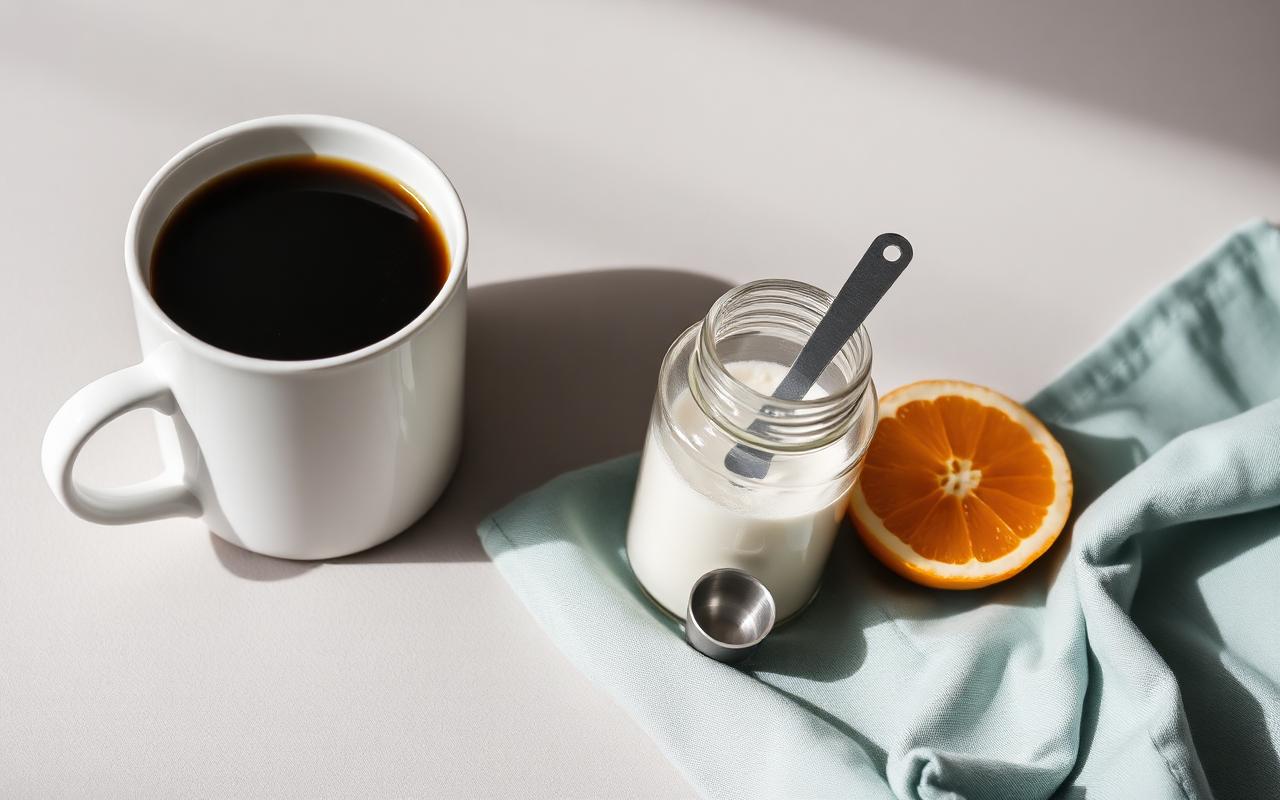
If, like me, you stir a scoop into your morning coffee, you're also adding around 8–10g of protein to a drink that previously had none. For midlife women — most of whom are under-eating protein — that's a genuinely useful head start on the day, before breakfast has even happened.
To be clear: collagen is not a complete protein and shouldn't replace your meat, fish, eggs, dairy or protein shake. It's a top-up, not a swap. Your muscle-building protein still needs to come from complete sources across the day.
Collagen won't outrun the basics
I'd be doing you a disservice if I let you think a scoop of powder is the answer. The things that protect your collagen — and your skin, joints and bones — cost nothing:
- Enough total protein spread across the day — the raw material for everything.
- Resistance training — loads tendons, ligaments and bone, and signals them to strengthen.
- Sleep — when the repair actually happens.
- Sun protection — UV is the single biggest external driver of collagen breakdown in skin.
- Vitamin C and colour on your plate — cofactors and antioxidants.
- Less alcohol, less added sugar, less chronic stress — all accelerate the loss.
Get those right and a good collagen supplement becomes the finishing touch it's meant to be.
What I take, and why
I came to collagen for joints, not for my skin. Years of lifting and competing left me wanting something that supported my hips — I was diagnosed with needing a hip replacement — and I wanted it unflavoured so it disappeared into my morning coffee without a fuss.
I use a grass-fed type I & III collagen from Hunter & Gather. It's unflavoured, dissolves easily, and — the important part — it fits my existing routine, so I don't forget it. I take mine with vitamin C. Hunter & Gather collagen on Amazon
I've also used Arbonne's Skin Elixir, which is a vegan formula — so rather than supplying animal collagen, it's designed to support your body's own collagen production, with vitamin C included. It's aimed at skin, hair and nails, it tastes pleasant, and it mixes into water or any cold or room-temperature drink, which makes it an easy one to keep up in the warmer months. See Skin Elixir and the full ingredient list
I've tried others along the way. Elevate is a good product with genuinely lovely customer service — I simply didn't get on with the taste, and I suspect that's the marine element for me rather than the product itself. Rheal and Nutrition Geeks are two more names women ask me about regularly and both have their fans. None of this makes them wrong for you; taste and texture are personal, and the one you enjoy is the one you'll keep taking.
Some of the links above are affiliate links, which means I may earn a small commission at no extra cost to you. I only ever share products I use myself, and I've named alternatives I don't earn from for exactly that reason.
So — does it work?
My honest answer: a well-formulated, properly dosed collagen supplement, taken consistently with vitamin C for at least three months, alongside enough protein and regular strength training, is a reasonable and worthwhile addition for many midlife women — particularly for skin hydration and elasticity, and for joints that have started to complain. It is not a miracle, and it will not compensate for a diet short on protein or a body that never gets loaded.
If you're taking medication, pregnant, or managing a health condition, do check with your GP or pharmacist first.
You may also enjoy
Keep reading — more practical advice from the Resource Hub.
Magnesium in Midlife — Why I Take Magnesium Glycinate Every Evening
Why magnesium glycinate is my evening non-negotiable for recovery, muscle function and nervous system health — and why active midlife women need to replace what exercise sweats out.
Read article
Omega-3 in Midlife — Why I Take It Every Day
Why omega-3 is one of my daily non-negotiables for midlife women — the omega-6 imbalance, what EPA and DHA actually do, and how a good omega-3 supports inflammation, heart, brain and recovery.
Read article
Vitamin D — The Hormone Most Midlife Women Are Missing
Vitamin D isn't really a vitamin — it's a hormone. Why it matters for bones, muscle, mood, immunity and metabolism in midlife, and what deficiency really looks like in women over 40.
Read articleCan't find a convenient time? Email me at hello@craftyourbody.com and I'll find a slot that works for you.